Tuesday, September 27, 2016

~My Weekly Report and Reflection 2~

Weekly Overview

            This week’s class began by answering some misconceptions about last week’s skyscraper activity.  This activity was being confused as having an open-ended question style instead of the exploratory style it was.  In order to show the difference, the class was put in groups and each person was given a random word or number.  The goal was to create a sentence describing our group by using each word or number at least once.  This was a great example to help clarify what constitutes an open ended question.  From this activity I learned that the opportunities were endless.  No two groups came up with the same answer.  By using open-ended questions, students are given completely free reign to create whatever they desire.  This differs from the skyscraper activity last week.  There was a certain way to complete the activity; however, we were not given those instructions.  The goal of this activity was to instead foster an exploratory or inquiry-based learning environment.  Although this was only a small part of our class, it did help clarify two very different yet equally important teaching styles that I hope to use in my future classrooms.
            For most of the remaining class time, we discussed the readings assigned: Relational Understanding and Instrumental Understanding by Richard Skemp (2006) and An Alternative Reconceptualization of Procedural and Conceptual Knowledge by Arthur Baroody, et al. (2007).  In groups, we discussed what we knew, what we learned, misconceptions, and remaining questions (I learned a lot from these articles, which I will address later on in this post).  Lastly, in the few remaining minutes at the end of the class, we were shown a few examples of different manipulatives that could be used in high school classrooms and were given a chance to explore them.

What did you learn/notice this week and how will it be useful to you?

            The most significant ideas that I can take away from this week are the ideas from Skemp (2006) and Baroody, et al.’s (2007) articles about procedural and conceptual knowledge and understanding.  Baroody (2007) defines procedural understanding as “knowledge of the procedure” and conceptual understanding as “knowledge of concepts and principles.”  To put it even simpler, procedural understanding is knowing how to properly do the steps, whereas conceptual understanding is understanding why we do these steps. 
Retrieved From: http://28htv21jkhic1fkybe2p0zo3lka.wpengine.netdna-cdn.com/wp-content/uploads/2015/01/procedural-and-conceptural-boxing-gloves.jpg

Growing up, I never really knew that there were two different types of understanding.  To me, understanding meant that I knew the steps and got the correct answer.  So looking back, procedural understanding was the most important.  As I began university and began taking education courses, I learned about the importance of conceptual understanding.  It started to become drilled in my head that conceptual understanding is the most important thing that students must take from their education.  However, this contradicted the way that I had always been taught.  I had always felt uneasy, because I still saw the importance of procedural knowledge and understanding, however, now I was supposed to focus more on conceptual understanding?  These readings were like the light at the end of the tunnel for me.  Skemp (2006) and Baroody (2007) taught me that although these are different concepts, they need to work together in order for a student to learn mathematics. One is not better than the other, nor should one be preferred over the other.  By working in tandem, students will gain the most from their education.  By teaching both procedural and conceptual understanding, not only will my future students be able to use the proper steps to solve a problem, but they will be able to look at their solution and answer the question, does this make sense? 

Are there any questions that you still have?

            Although we did discuss it this week, I do wish that we spent more exploring and using manipulatives.  Thinking back to my elementary and high school experiences, I cannot recall ever being given the opportunity to use manipulatives in my math classrooms.  Therefore, I have very little knowledge and experience on when to use manipulatives or even how to use them properly.  This was evident when we were given time to explore some manipulatives – I had no idea how to start some activities.  I knew how to answer the question with a pencil and paper, but I had no idea how to even attempt to answer it using the manipulatives.  This is unfortunate because I believe that manipulatives can be such a great tool for students to not only solidify their procedural understanding, but also their conceptual understanding.  It almost scares me that although I badly want to have these resources available for my students to use, I have almost no idea how to use them.  For this reason, I wish I was provided with more examples of manipulatives and the proper way to use them in a classroom.
Retrieved From: http://www.rainbowresource.com/products/mkcmmk.jpg

Tuesday, September 20, 2016

~My Weekly Report and Reflection 1~


Weekly Overview

This week’s class mainly focused on what teachers can expect to find in the mathematics curriculum documents for grades 1-8, 9-10, and 11-12.  We discussed the different strands that are found in most high schools, including prerequisites needed and post-secondary options.  We also reflected on the different math processes found in the curriculum.  These processes include problem solving, reasoning and proving, reflecting, connecting, communicating, and selecting tools and computation strategies.  To finish up, the class worked in groups to try to solve a math-logic skyscraper puzzle, without being given any instructions, in order to reflect on our own learning strategies and how they relate to the math processes previously discussed.

Are there instances from the activity that will help you think differently?

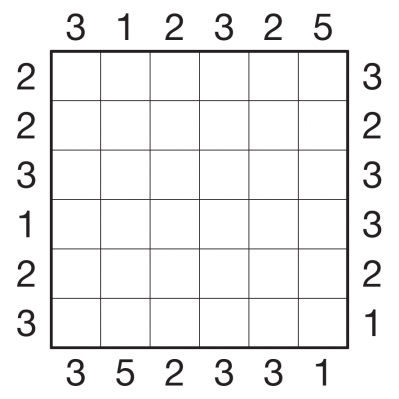
I was surprised to learn a lot from the skyscraper puzzle!  When the activity was first given out, there was not any instruction provided.  We were only given handouts that looked similar to this:
Retrieved from: http://www.anypuzzle.com/puzzles/logic/Skyscraper/example-big.png
Now if I’m being completely honest, I’m still not 100% clear on what the correct instructions are!  The little guidance that we later received was that if a person was standing on a number and looking towards the boxes, the number of blocks they would “see” should be the same number they are standing on.  The actual instructions differ slightly, however the underlying idea is the same (I will link the actual instructions at the end of this entry).
            As my group and I continued to attempt the puzzle (with no success), our instructor walked by to check our progress.  In doing so, she let us know that she had previously used this activity on young elementary school students, and many of them were able to figure out the problem with no problems or need for guidance.  Yes, you heard that right.  Seven to ten year olds could figure this puzzle out but my peers and I, who have degrees in mathematics, were completely stumped.
            This made me think a lot about differentiated learning.  The way that I learn and understand things is very different from the way others may learn.  This is extremely important to remember as a future teacher.  The instruction I received when I was in high school may have worked for me and my fellow students, but that might not be the case in today’s schools.  There are some students who thrive with minimum instruction, and others who are completely lost.  Not every student is the same, so not all students learn the same.  It’s tremendously important that as I create lesson plans, I consider what I’ve learned here for my future students.
            Now, although I had a difficult time with the skyscraper activity, it was fun to do – which reflects on my teaching philosophy!  Not only was this a fun and memorable puzzle to do, but it also challenges students on some of the math processes we had discussed prior to doing the activity.  Through the use of this puzzle, I believe that students will develop their problem solving, communication, and reasoning skills.  In the real world, students are not always going to be handed step-by-step instructions on how to solve every problem they run into.  By doing this activity without being given any instruction, students must figure out what they already know and how to use what they know to solve the problem.  While working in groups, students need to effectively communicate their ideas to the peers and reason with them about why their ideas make sense.  This allows students to learn new things, solve problems, and develop their math processes, all while being unaware due to the fun they are having.

Overall, this was an activity that I will definitely keep in my back pocket to use in the future, and I think that others should too.  If you are reading this and are interested in trying these puzzles for yourself, here are some links that let you try them online:

Monday, September 19, 2016

~Introducing Me~

My name is Heather.  I am currently a teacher candidate at Brock University, enrolled in the Intermediate/Senior Concurrent Education Program.  I have a Bachelor of Science, concentrated in Mathematics, with a teachable for Biology.

Math is typically considered a boring and useless class for many high school students and I want to challenge that assumption.  Similar to most of my peers, math has always been a fun and interesting subject for me growing up.  In high school I could never understand why my fellow students hated going to math class - it was always my favourite part of the day.  For these reasons, I want to inspire students' curiosity and desire to learn mathematics by making lessons fun and exciting.  I firmly believe that when students are enjoying what they are learning, they are not only more likely to engage in the material they are learning, but they are also more likely to remember it in the future.  In order to do this, I am excited to gain inspiration, not only from my courses, but from the teachers and students I will get the pleasure to meet and learn from during my practicum experiences.


This blog is for me to reflect and record what I learn from both my classes and my practicum experiences and discuss how they have influenced my views on teaching.